
Check a VAT number is written correctly.
Type a supplier’s VAT number to check its format: the right number of digits, and check digits that match. It is checked in your browser and never sent anywhere.
To see whom a number is registered to, use HMRC’s Check a UK VAT number (opens in a new tab).
Check a whole supplier list.
Paste the VAT numbers from a client’s supplier list, or copy the name and VAT number columns from Excel. Every number is checked at once, and the ones to look at again are marked.
Download the results as a CSV file for the client’s working papers. A list with a heading row, such as a supplier list exported from your software, is read by its headings.
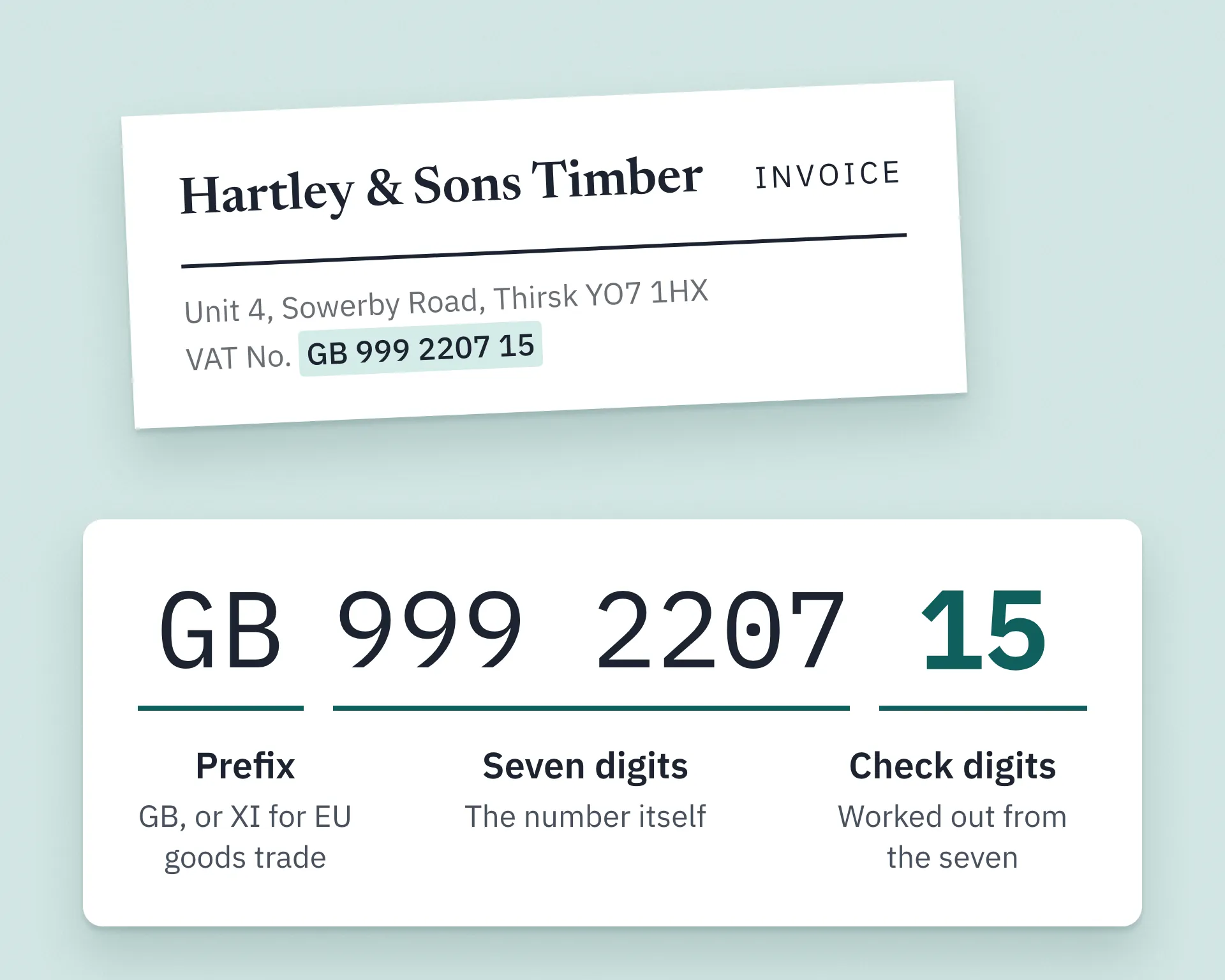
The format of a UK VAT number.
- Nine digits
- Every UK VAT registration number has nine (HMRC, EM3058 (opens in a new tab)), and the business must put it on every invoice it raises (GOV.UK (opens in a new tab)). GB in front is optional when you check it.
- XI in front
- The same nine digits, for a business in Northern Ireland trading in goods with the EU (GOV.UK (opens in a new tab)). Not needed on invoices for services or UK sales (VATNIEU2100 (opens in a new tab)).
- Twelve digits
- The nine and three more, which the EU’s VIES lists as identifying branch traders (VIES (opens in a new tab)). The check digits are tested on the first nine.
- GD or HA and three digits
- Government departments and health authorities (VATGPB9400 (opens in a new tab); VIES (opens in a new tab)). Three digits leave no check digits to test.
How the check digits work.
The last two digits are worked out from the seven before them (EM3058 (opens in a new tab)). HMRC does not publish the formula; one of its manuals calls it a “modulus 97” check (VATAFRS2500 (opens in a new tab)).
Accounting software uses the rule worked through here, and so does this page. A digit copied wrongly almost always breaks it, and two neighbouring digits swapped always do.
In October 2026 we tried it on 21 VAT numbers printed on real receipts and invoices from UK suppliers: 20 passed, and the one that failed was printed that way on the supplier’s own invoice.
HMRC’s own examples fail: the number on the example invoice in VAT Notice 700, 987 6543 21, is made up (Notice 700, 16.7 (opens in a new tab)).
A made-up number.
| Digit | 9 | 9 | 9 | 2 | 2 | 0 | 7 |
|---|---|---|---|---|---|---|---|
| Times | 8 | 7 | 6 | 5 | 4 | 3 | 2 |
| Result | 72 | 63 | 54 | 10 | 8 | 0 | 14 |
- Results added up
- 221
- Plus the check digits, 15
- 236
- Not a multiple of 97, so plus 55
- 291
291 is 3 × 97, so the number passes.
What the check cannot tell you.
A number written correctly may still not be a current registration, or may belong to someone else: HMRC says a format check cannot tell (EM3058 (opens in a new tab)).
For the registered name and address, use HMRC’s Check a UK VAT number (opens in a new tab). If you are VAT registered and give your own number too, it records when you checked. Registrations from the last 48 hours may not show yet (EM3058 (opens in a new tab)).
Finding a supplier’s VAT number.
- On the invoice, receipt or website
- Where most businesses’ numbers can be found (GOV.UK (opens in a new tab)). A full VAT invoice, a simplified one for £250 or less and a retailer’s VAT invoice must all show it (Notice 700, 16.3.1 (opens in a new tab), 16.6.1 (opens in a new tab), 16.6.2 (opens in a new tab)).
- Not by name
- HMRC’s service only checks a number you already have; it will not search by business name (GOV.UK (opens in a new tab)). Nor will the EU’s VIES (VIES (opens in a new tab)).
- Not on Companies House
- Its register shows a company’s address, officers, filings, charges, previous names and insolvency, not its VAT number (GOV.UK (opens in a new tab)). The company number printed beside it on some invoices is a different number.
- Ask the supplier
- HMRC says you should have no problem finding out from your suppliers whether they are registered, and to go back to them for a VAT invoice you do not have (19.5.1 (opens in a new tab), 19.5.3 (opens in a new tab)).
Questions about checking VAT numbers.
Does it show whom a number belongs to?
No. It checks how the number is written. HMRC’s Check a UK VAT number (opens in a new tab) shows the business name and address it is registered to.
Is what I type sent anywhere?
No. The check runs in your web browser: the numbers and names you type or paste are not sent to Daybook or anyone else, and this website sets no cookies.
What should I do when a supplier’s number fails?
Compare it with the invoice first: most failures are a digit typed or read wrongly. If the invoice shows the same number, ask the supplier to confirm it before the VAT is reclaimed.
Only a VAT-registered business can issue a VAT invoice, and knowingly reclaiming VAT on one from a business that is not registered is an offence (Notice 700, 19.5.1 (opens in a new tab)). Issuing one can bring a penalty (Finance Act 2008, Schedule 41 (opens in a new tab)).
Can I check EU VAT numbers here?
No, only UK ones. EU numbers, and Northern Ireland’s XI numbers, can be checked on the EU’s VIES (opens in a new tab), which no longer checks GB numbers.
Where do I find my own VAT number?
In your VAT online account, and on your VAT registration certificate (GOV.UK (opens in a new tab)).
Sources
Every fact on this page was checked against these on 15 October 2026.
- Check a UK VAT number (opens in a new tab), GOV.UK, updated 28 February 2023.
- Check a UK VAT number: enter the VAT number (opens in a new tab), HMRC.
- Enquiry Manual, EM3058: VAT registration numbers (opens in a new tab), HMRC, updated 11 August 2021.
- Register for VAT: after you register (opens in a new tab), GOV.UK, updated 10 October 2024.
- Register for VAT: selling or moving goods between Northern Ireland and the EU (opens in a new tab), GOV.UK, updated 10 October 2024.
- VAT Northern Ireland and the EU Manual, VATNIEU2100 (opens in a new tab), HMRC, updated 16 June 2026.
- VAT Registered Companies API, version 2.0 (opens in a new tab), HMRC Developer Hub, updated 14 October 2026.
- VIES VAT number validation, questions and answers (opens in a new tab), European Commission.
- VAT Government and Public Bodies Manual, VATGPB9400 (opens in a new tab), HMRC, updated 21 May 2021.
- VAT Agricultural Flat Rate Scheme Manual, VATAFRS2500 (opens in a new tab), HMRC, updated 20 June 2022.
- VAT Notice 700, paragraph 16.7: example of a completed VAT invoice (opens in a new tab), HMRC, updated 25 June 2026.
- VAT Notice 700, paragraph 16.3.1: full VAT invoices (opens in a new tab), HMRC, updated 25 June 2026.
- VAT Notice 700, paragraph 16.6.1: simplified VAT invoices (opens in a new tab), HMRC, updated 25 June 2026.
- VAT Notice 700, paragraph 16.6.2: retailers’ VAT invoices (opens in a new tab), HMRC, updated 25 June 2026.
- Get information about a company (opens in a new tab), GOV.UK, updated 24 October 2017.
- VAT Notice 700, paragraph 19.5.1: evidence for reclaiming VAT (opens in a new tab), HMRC, updated 25 June 2026.
- VAT Notice 700, paragraph 19.5.3: if you do not hold a VAT invoice (opens in a new tab), HMRC, updated 25 June 2026.
- Finance Act 2008, Schedule 41, paragraph 2 (opens in a new tab), legislation.gov.uk.
- Pay your VAT bill (opens in a new tab), GOV.UK, updated 13 December 2024.
Every supplier VAT number, checked as it is read.
Daybook Capture reads your clients’ receipts and purchase invoices and runs the same check digit test on every UK VAT number it finds. One that fails is flagged, to compare with the original.
Free for 14 days, up to 50 documents. No card needed.