
Till receipt or VAT invoice.
A till receipt can be a VAT receipt, or only a record of what was paid. Here is what a simplified VAT invoice must show, when a full VAT invoice is needed, which card slips count, and what to do when a client has no VAT receipt.
Last updated
In short
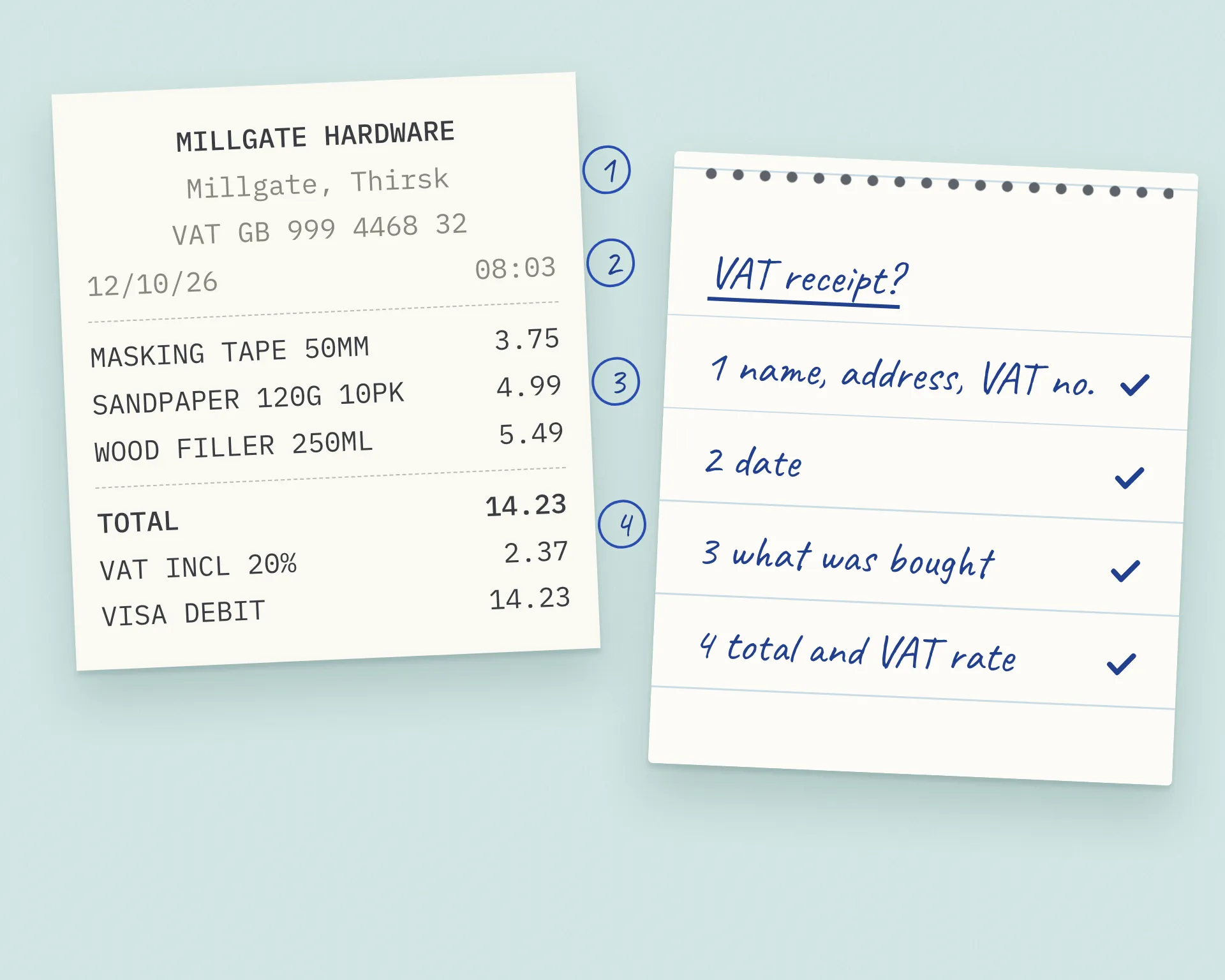
- A till receipt is a VAT receipt, a simplified VAT invoice in HMRC’s words, when it shows the shop’s name, address and VAT number, the date, what was bought and, for each VAT rate, the total and the rate.
- It need not show the VAT amount. At 20%, the VAT is one sixth of a total that includes it.
- A simplified VAT invoice covers £250 or less. Above that, or when the customer asks, the supplier gives a full VAT invoice.
- A card slip counts once it shows the VAT number, the rate and what was bought. A pro-forma invoice cannot be used to reclaim VAT.
- With no VAT invoice, go back to the supplier first. For a VAT-registered client, Daybook checks the digits of every UK VAT number it reads, and sends a receipt that charges VAT with no VAT number read to review.
For a VAT-registered client, Daybook checks the check digits of each UK VAT number it reads, and sends a receipt that charges VAT with no VAT number to review with a note. What Daybook reads from a receipt
Contents
What a simplified VAT invoice must show
A business can give a simplified VAT invoice when the supply is £250 or less and the customer agrees. It must include:1
- the supplier’s name, address and VAT registration number
- the time of supply (the tax point)
- a description that identifies the goods or services
- for each VAT rate, the total including VAT and the rate
A till receipt that shows all four is a VAT receipt. HMRC calls it a simplified VAT invoice, and some of its paragraphs still say less detailed VAT invoice.2
The VAT amount is not on the list. The total and the rate are enough: at 20%, the VAT is one sixth of a total that includes it, so the receipt in the picture, for £14.23, holds £2.37 of VAT.2
The VAT number is. It is required on a simplified VAT invoice, a retailer’s VAT invoice and a full VAT invoice alike.1,3,4
A receipt with goods at two rates, such as a supermarket shop, shows a total for each rate (VAT on supermarket receipts).
When a full VAT invoice is needed
A shop must give a full VAT invoice for a sale of more than £250, or for less when the customer asks for one.3 A full VAT invoice shows more:4
- a sequential number that identifies the invoice
- the time of supply, and the date of issue if it is different
- the supplier’s name, address and VAT registration number
- the customer’s name and address
- a description of the goods or services, with the quantity, the VAT rate and the amount excluding VAT for each
- the total excluding VAT and the rate of any cash discount
- the total VAT, in sterling
- the unit price
Zero rated or exempt items on a VAT invoice must show clearly that no VAT is payable, with a separate total.5 For petrol or diesel over £250, the invoice can show the vehicle’s registration number instead of the customer’s name and address.6
Card slips, pro-formas and “not a VAT invoice”
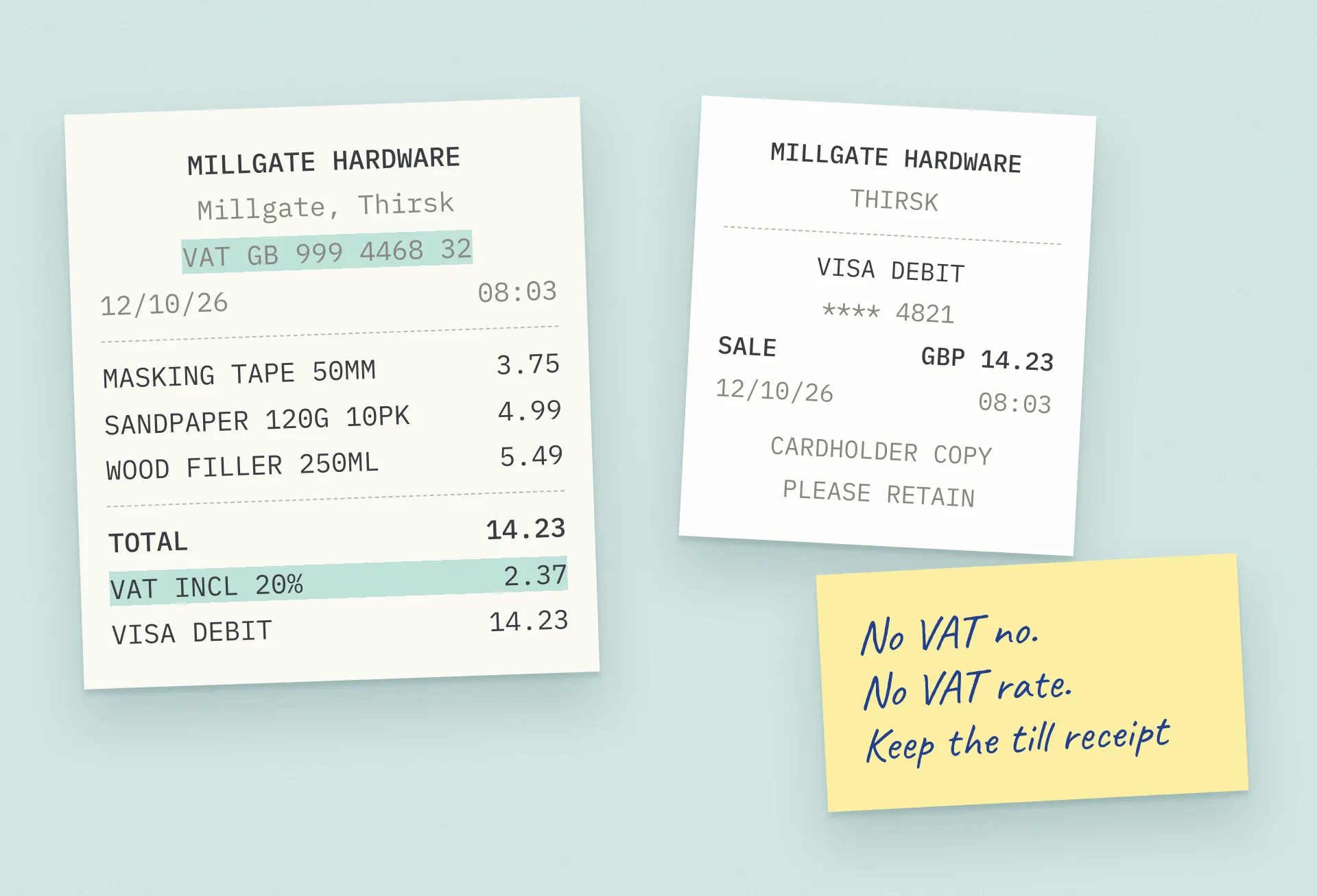
A card machine slip shows the shop’s name and address, the amount including VAT and the date. It can serve as a VAT receipt once the shop adds its VAT registration number, the rate of VAT and a description of what was sold. When a receipt comes with the slip, only one of the two may be the VAT invoice.3 A slip without those details is not a VAT receipt, so look at the till receipt that came with it.
A pro-forma invoice cannot be used to reclaim VAT, even when it shows everything a VAT invoice needs, and HMRC asks for it to be marked “this is not a VAT invoice”. Once the goods or services are supplied or paid for, the supplier must issue a proper VAT invoice.7 An invoice marked pro-forma or “this is not a tax invoice” cannot be used either.8
When there is no VAT invoice
HMRC’s first step is to go back to the supplier and ask for a VAT invoice that meets the requirements. If the supplier cannot provide one, the business has to satisfy HMRC that:9
- there was a supply of goods or services
- it took place in the UK
- it is taxable at the standard or reduced rate
- the supplier is registered for VAT, or should be
- the supply was made to the business claiming the VAT
- that business was registered for VAT, or should have been, at the time
- it is to be used for the business
It also needs other evidence that the purchase took place.9
A few purchases of £25 or less including VAT need no VAT invoice: phone calls, coin-operated machines, car park charges and tolls paid at the tollbooth. The rule covers only these.10
Only a VAT registered business can issue a VAT invoice, and knowingly reclaiming VAT on an invoice from one that is not is an offence.8 HMRC’s Check a UK VAT number (opens in a new tab) shows whether a number is valid and the name and address it is registered to.11 To see first whether a number is written correctly, use our VAT number format check.
How Daybook reads VAT receipts
For a VAT-registered client, Daybook reads the supplier’s VAT number from each receipt and invoice and, for a UK number, checks its check digits. A number that fails goes to review with a note that it may have been misread.
A receipt that charges VAT with no VAT number read goes to review too, with the note “VAT is charged but no VAT number was read. If one is printed, type it in: HMRC needs a valid VAT invoice to reclaim it.” If the number read is the client’s own, Daybook says the supplier and the buyer may have been mixed up.
A supplier with no VAT number that charged no VAT goes into the import files for accounting software as No VAT, outside the VAT system, unless the document prints a 0% rate or the supplier is set to Zero rated or Not VAT registered: then it goes in at the zero rate, which counts in box 7 of the VAT return.
Doing this for clients every month? Try Daybook on one client’s month: free for 14 days, no card needed.
Questions
Is a till receipt a VAT receipt?
For £250 or less, yes, when it shows the shop’s name, address and VAT number, the date, what was bought and, for each VAT rate, the total including VAT and the rate. It is then a valid VAT receipt, a simplified VAT invoice in HMRC’s words.1
What is a simplified VAT invoice?
Does a VAT receipt need to show the VAT amount?
Does a VAT receipt need to show the VAT number?
Is a card receipt a VAT receipt?
Only once it also shows the shop’s VAT registration number, the rate of VAT and what was bought.3
Read next
- VAT on supermarket receiptsZero and standard rated items on one till receipt, the codes, and a line for each rate.
- Handwritten receipts and VATWhen a receipt written by hand is a VAT receipt, one with no VAT number, and cash payments.
- VAT number format checkThe digits and check digits of one number or a whole supplier list.
- What Daybook reads from a receiptThe same job in Daybook Capture, for every client.
Sources
Every fact on this page was checked against these on 27 October 2026.
- VAT Notice 700, paragraph 16.6.1: simplified VAT invoices (opens in a new tab), HMRC, updated 25 June 2026.
- VAT Notice 700, paragraph 7.3.1: VAT fractions (opens in a new tab), HMRC, updated 25 June 2026.
- VAT Notice 700, paragraph 16.6.2: retailers’ VAT invoices (opens in a new tab), HMRC, updated 25 June 2026.
- VAT Notice 700, paragraph 16.3.1: full VAT invoices (opens in a new tab), HMRC, updated 25 June 2026.
- VAT Notice 700, paragraph 16.5: invoicing for zero-rated or exempt supplies (opens in a new tab), HMRC, updated 25 June 2026.
- VAT Notice 700, paragraph 17.1: VAT invoices for petrol and diesel (opens in a new tab), HMRC, updated 25 June 2026.
- VAT Notice 700, paragraph 17.3: pro-forma invoices (opens in a new tab), HMRC, updated 25 June 2026.
- VAT Notice 700, paragraph 19.5.1: evidence for reclaiming VAT (opens in a new tab), HMRC, updated 25 June 2026.
- VAT Notice 700, paragraph 19.5.3: if you do not hold a VAT invoice (opens in a new tab), HMRC, updated 25 June 2026.
- VAT Notice 700, paragraph 19.5.9: other circumstances, supplies of £25 or less (opens in a new tab), HMRC, updated 25 June 2026.
- Check a UK VAT number (opens in a new tab), GOV.UK, updated 28 February 2023.