
Handwritten receipts and VAT.
Tradespeople, markets and small suppliers still write receipts by hand. Here is when a handwritten receipt is valid for VAT, what it must show, what a receipt with no VAT number means, and how to keep a photo of one.
Last updated
In short
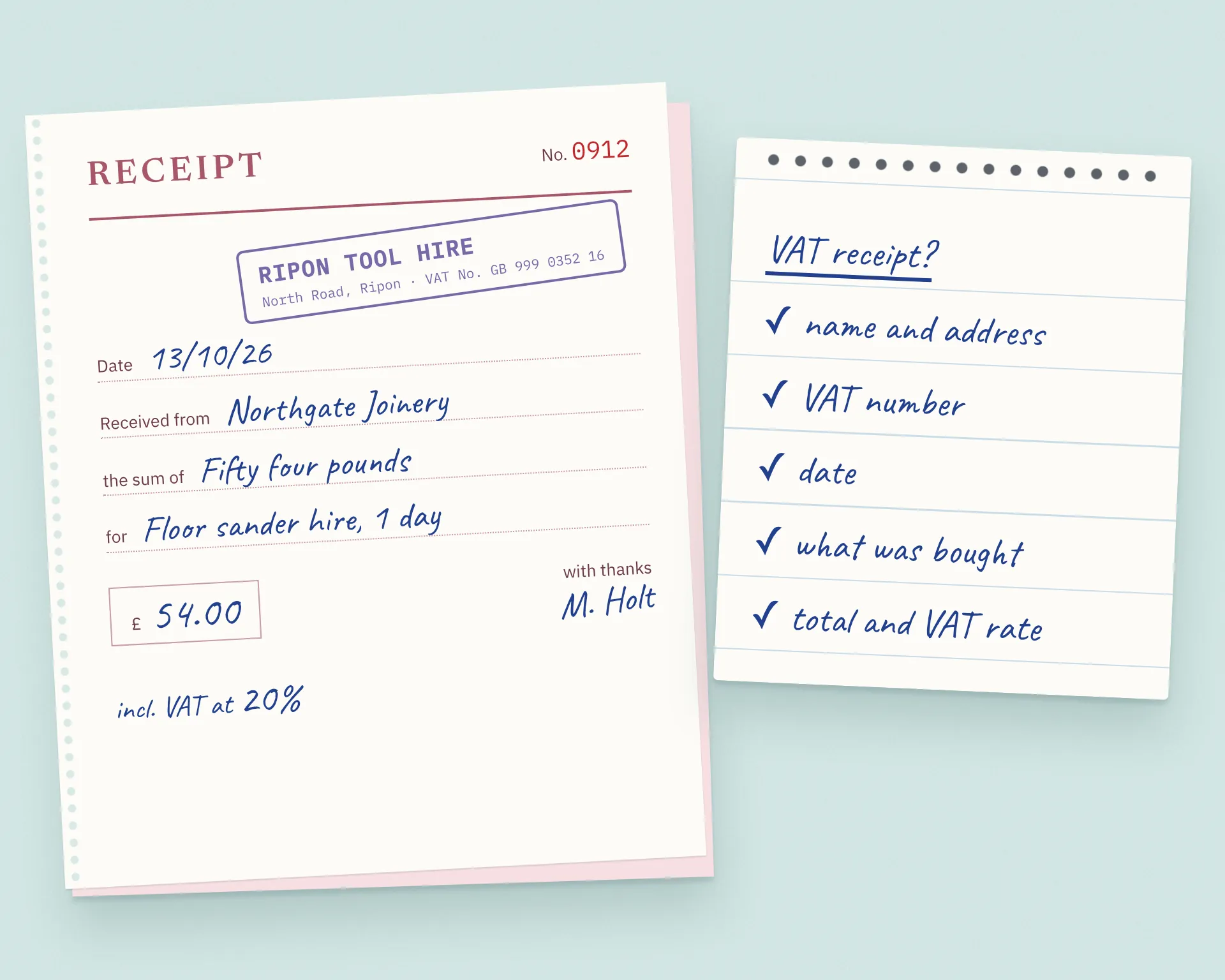
- HMRC sets what a VAT invoice shows, not how it is made: handwritten is fine.
- Up to £250: the supplier’s name, address and VAT number, the date, what was bought, and the total and VAT rate.
- Without a VAT number it is not a VAT invoice; if no VAT was charged, there is none to claim. It is still a business record.
- Without a valid VAT invoice, go back to the supplier and ask for one first.
Daybook reads handwritten receipts and receipt books, marks handwritten amounts to check against the image, and never approves such a receipt on its own. What Daybook reads from a receipt
Contents
Is a handwritten receipt valid for VAT?
HMRC sets out what a VAT invoice must show, not how it is produced. Its notice treats paper as the ordinary case: an electronic invoice “must include all the information that’s required on a paper VAT invoice”.1
So a receipt written by hand, from a supplier registered for VAT, is a VAT receipt when it shows the details below. One that leaves them out is a receipt, not a VAT invoice.
What a handwritten VAT receipt must show
For a supply of £250 or less, a simplified VAT invoice is enough. It shows:2
- the supplier’s name, address and VAT registration number
- the time of supply, the date
- a description of what was bought
- for each VAT rate, the total including VAT and the rate
Over £250, or when the customer asks, a full VAT invoice adds a sequential number, the customer’s name and address, quantities, the amounts excluding VAT and the total VAT in sterling.3 Duplicate receipt books, with numbered pages and a copy, give the sequential number for free.
A handwritten receipt with no VAT number
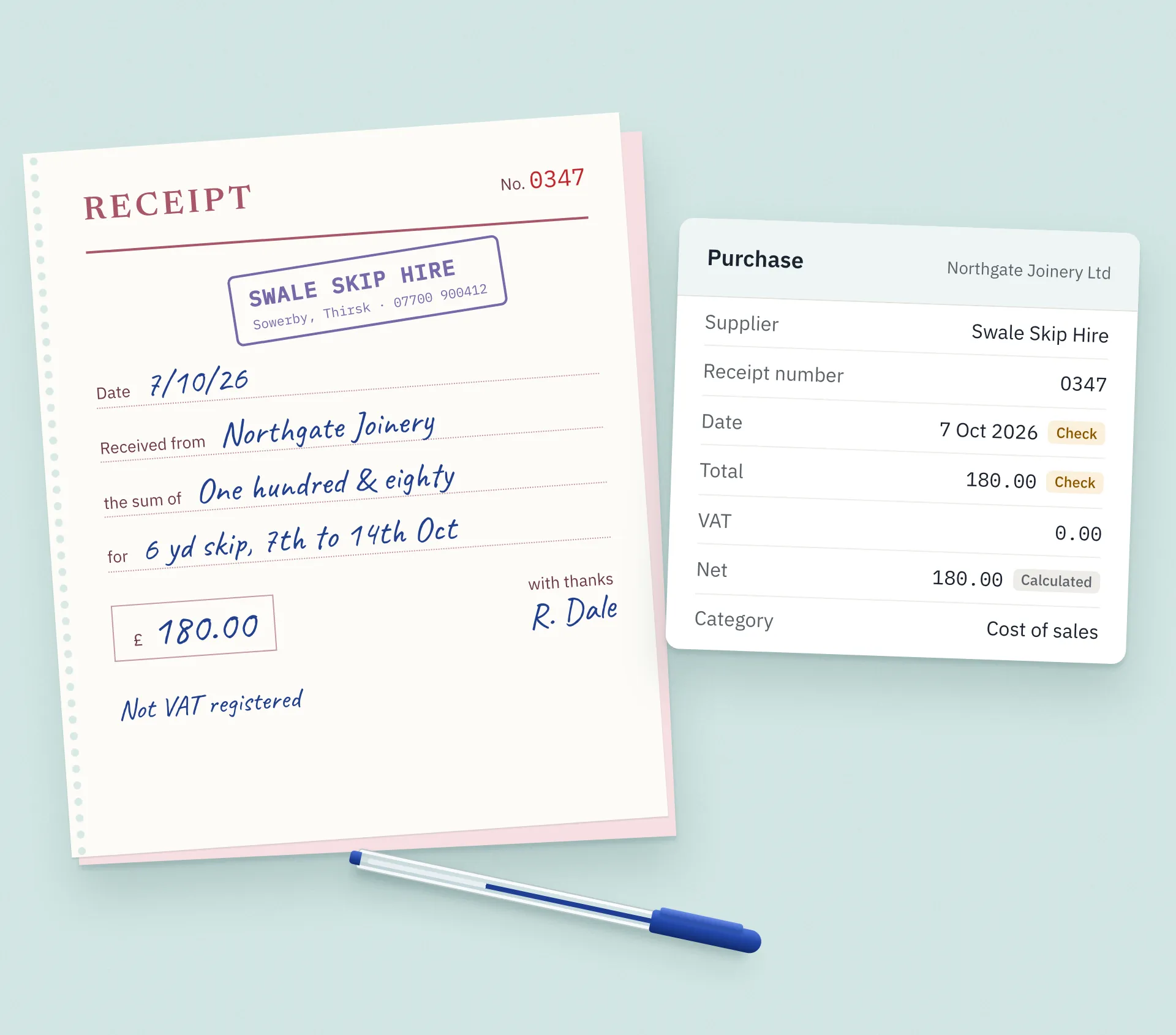
A VAT invoice is something a VAT-registered business gives another one for a standard or reduced rated supply.4 A handwritten receipt from a sole trader who is not VAT registered, a skip hire or a window cleaner, has no VAT number because there is no VAT on it: there is nothing to reclaim.
It is still a business record. A sole trader keeps records of all business expenses, and receipts are part of the proof.5
A handwritten receipt for a cash payment
Paying cash makes no difference to what the receipt needs: ask for the supplier’s name and address, the date, what it was for and the amount, and the VAT number and rate if VAT is charged.
Without a valid VAT invoice, HMRC’s first step is to go back to the supplier and ask for one. Only if that fails can other evidence show the VAT was charged by a registered business for a business supply.6
Keeping a photo of a handwritten receipt
A kept image can stand in for the paper when it contains all the detail required for VAT.7 Handwriting is easier to misread than print, so photograph it flat and sharp, with the amounts and the VAT number clear, and keep the book’s copy until the photo has been checked.
Handwritten receipts in Daybook
Daybook reads handwritten receipts, receipt books and stamped slips included, and marks handwritten amounts: “Some amounts are handwritten. Check them against the image.” Such a receipt goes to review, with the photo beside the figures, and is never approved on its own.
A receipt with no VAT number and VAT shown is flagged too, and nothing that cannot be read is guessed (how Daybook reads receipts).
Doing this for clients every month? Try Daybook on one client’s month: free for 14 days, no card needed.
Questions
Is a handwritten receipt legal in the UK?
Yes. HMRC sets what a VAT invoice must show, and paper is the ordinary case.1 A handwritten receipt with the right details is a VAT receipt.
Can I claim VAT on a handwritten receipt?
If it shows the supplier’s name, address and VAT number, the date, what was bought, and the total and VAT rate, yes.2 Without a VAT number it is not a VAT invoice: ask the supplier for one. If no VAT was charged, there is none to claim.
What should a handwritten receipt for a cash payment include?
The supplier’s name and address, the date, what it was for and the amount, plus the VAT number and rate when VAT is charged.2
Read next
- Till receipt or VAT invoiceWhat a simplified VAT invoice must show, card slips, and what to do without one.
- Faded till receiptsPhotographing them the day they arrive, a faint receipt, and one that has already faded.
- VAT codes for purchasesEach program’s purchase VAT codes, box 7, and the code for a supplier not VAT registered.
- What Daybook reads from a receiptThe same job in Daybook Capture, for every client.
Sources
Every fact on this page was checked against these on 27 October 2026.
- VAT guide (VAT Notice 700), paragraph 17.7: electronic invoicing (opens in a new tab), HMRC, updated 25 June 2026.
- VAT Notice 700, paragraph 16.6.1: simplified VAT invoices (opens in a new tab), HMRC, updated 25 June 2026.
- VAT Notice 700, paragraph 16.3.1: full VAT invoices (opens in a new tab), HMRC, updated 25 June 2026.
- VAT Notice 700, paragraph 16.2.1: VAT invoices (opens in a new tab), HMRC, updated 25 June 2026.
- Business records if you’re self-employed: what records to keep (opens in a new tab), GOV.UK.
- VAT Notice 700, paragraph 19.5.3: if you do not hold a VAT invoice (opens in a new tab), HMRC, updated 25 June 2026.
- Record keeping (VAT Notice 700/21), section 6: keeping digital and original records (opens in a new tab), HMRC, updated 18 March 2024.