
VAT on supermarket receipts.
A supermarket shop for a client’s business can put zero rated food and standard rated goods on one till receipt. This guide covers which items carry VAT, what the VAT codes on the receipt mean, when it counts as a VAT receipt, and how to book it at each rate.
Last updated
In short
- Most food is zero rated. Confectionery, chocolate biscuits, crisps, soft drinks, bottled water and alcohol are standard rated at 20%, as are most goods other than food.
- The letter or mark beside each price is its VAT code. Read what it means from the receipt’s own VAT summary or key.
- A till receipt is a VAT receipt when it shows the shop’s name, address and VAT number, the date, what was bought and, for each VAT rate, the total and the rate. If it does not, ask the shop for one.
- Only the VAT on items for the business can be claimed. Zero rated items carry none, but keep the receipt for them too.
- Book it as one purchase with a line for each VAT rate. Daybook reads the VAT at each rate, with a line for each rate in the import files that take them.
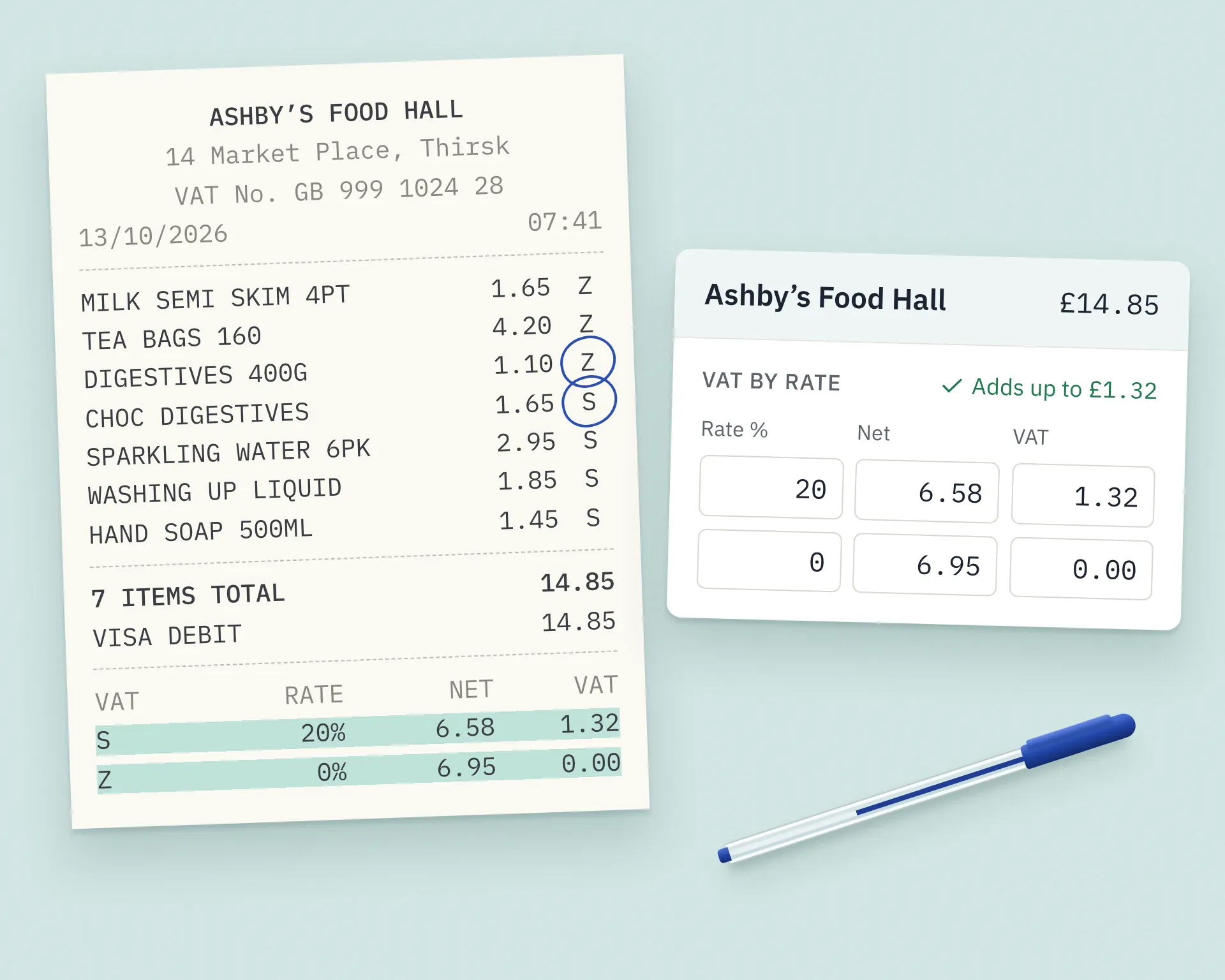
Daybook reads the VAT at each rate from the receipt’s VAT summary, checks it against the net and the VAT total, and shows it as VAT by rate beside the receipt. What Daybook reads from a receipt
Contents
Which supermarket items carry VAT
Most food is zero rated, but HMRC lists foods that are always standard rated, so one supermarket shop can hold both.1 HMRC’s and GOV.UK’s examples, by rate:
- Zero rated, 0%
- Most food, such as milk and bread, with tea and coffee and plain biscuits and cakes.1,2 Children’s clothes are zero rated too.3
- Standard rated, 20%
- Sweets and chocolate, chocolate biscuits, crisps and roasted or salted nuts, ice cream, soft drinks and bottled water, beer and wine.1,2,4 Most other goods, such as washing up liquid: the standard rate applies to most goods and services.3
- Reduced rate, 5%
- A few goods, such as children’s car seats.3
- Exempt
- Postage stamps carry no VAT.3
VAT codes on a supermarket receipt
Shops mark the VAT on a till receipt in their own way, so read the codes from the receipt itself. Sainsbury’s says the products marked with an asterisk (*) on its till receipt are subject to VAT.5 On the receipt in the picture, each price carries a letter, and the VAT summary at the foot says what each letter stands for: S at 20% and Z at 0%, with the net amount and the VAT of each.
Whatever the marks, the part that matters is the summary by rate. A retailer’s VAT invoice has to show, for each VAT rate, the total including VAT and the rate.6
When only VAT-inclusive totals are printed, the VAT in each comes from the VAT fraction: one sixth at 20%, one twenty-first at 5%.7 The standard rated goods on the receipt in the picture come to £7.90, which holds £1.32 of VAT.
Is a supermarket receipt a VAT receipt?
It can be. HMRC counts a receipt as a VAT invoice when it meets the requirements in section 16.3 or 16.6 of the VAT guide.8 For a sale of £250 or less, a retailer’s VAT invoice must show:6
- the shop’s name, address and VAT registration number
- the time of supply (the tax point)
- a description that identifies the goods
- for each VAT rate, the total including VAT and the rate
A till receipt with all of these is a VAT receipt. One without the VAT number or the rates is not, and HMRC’s first step then is to go back to the shop and ask for a VAT invoice.8
The shop should give one when asked, and can face a penalty for refusing a VAT registered business. For more than £250, or when the customer asks, it must be a full VAT invoice.6
Full VAT invoices and card slips are in the guide to till receipts and VAT invoices.
Getting a VAT receipt from Tesco or Sainsbury’s
- Tesco, in store
- Take the original till receipt to the Customer Service Desk, where a VAT invoice can be completed while you wait. Tesco’s page adds that the details on some VAT receipts may be limited by a technical issue it is working to resolve, so check the VAT receipt shows everything listed above.9
- Tesco Marketplace
- For items from a Marketplace seller, Tesco says to ask the seller directly.10
- Sainsbury’s, in store
- Ask at the Customer Service Desk, or at the kiosk in a smaller local or convenience store.5
- Sainsbury’s online groceries
- By phone, on the number Sainsbury’s gives on its help page.5
- Any other shop
- Ask the shop: a retailer should give a VAT invoice when asked for one.6
Claiming the VAT on a supermarket receipt
Input tax is the VAT charged on business purchases and expenses.11 From a supermarket receipt, that means:
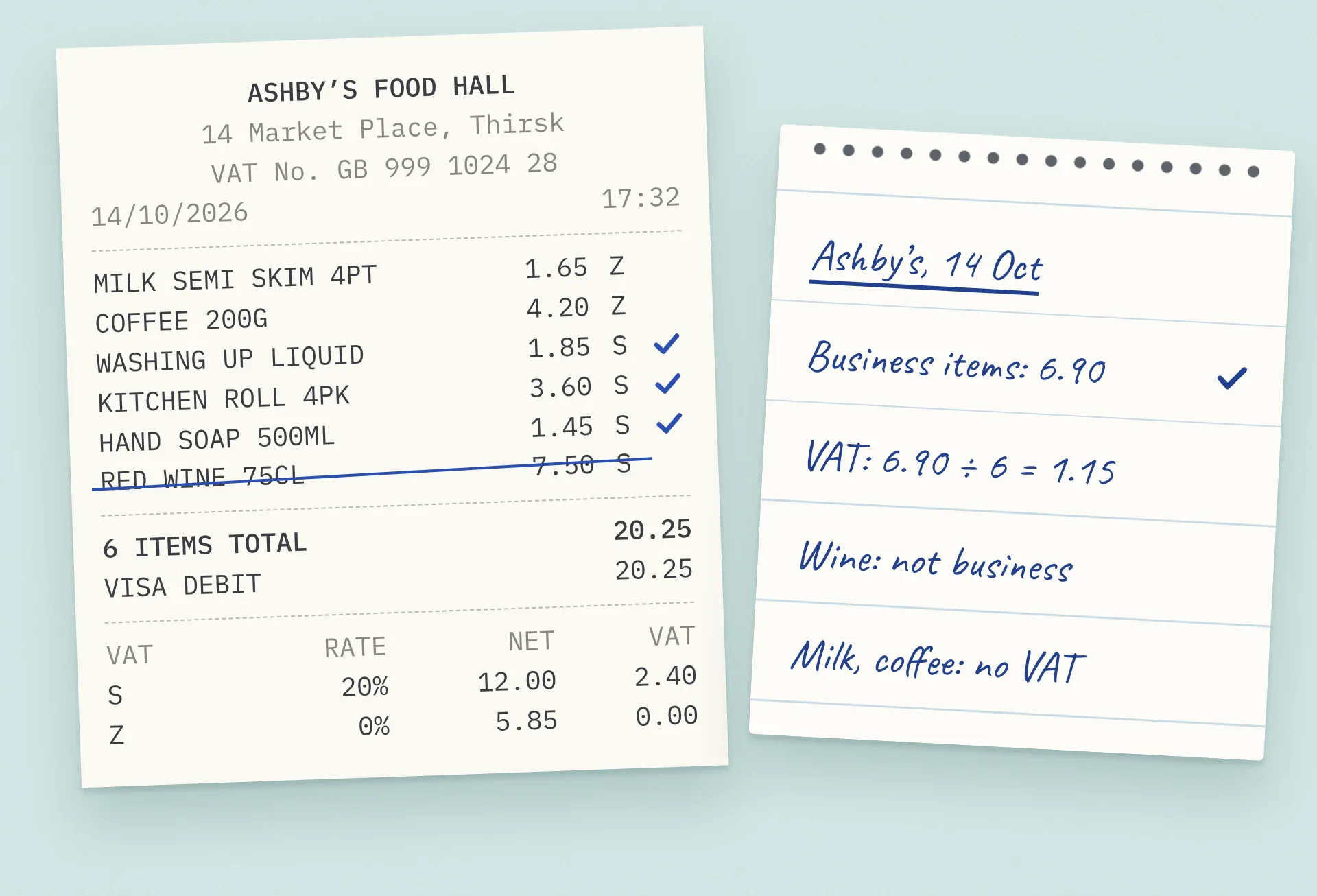
Only the items for the business. VAT on goods not used for the business, and on business entertainment, cannot normally be reclaimed.12 When a client’s shop mixes the two, only the VAT on the business items counts: at 20%, a sixth of what they cost.7
Only the items that carry VAT. Zero rated food has no VAT to reclaim, but the receipt is kept all the same: HMRC says invoices for zero rated supplies must be kept as well as the rest.13
A VAT receipt, whatever the amount. HMRC’s rule that some purchases of £25 or less need no VAT invoice covers only phone calls, coin-operated machines, car park charges and tolls paid at the tollbooth.14 Shopping is not on that list.
Splitting a supermarket receipt by VAT rate
In the books, a receipt with two rates is one purchase with a line for each rate. In Xero, the zero rated goods go on a line at Zero Rated Expenses and the rest on a line at 20% (VAT on Expenses), Xero’s own names for the UK rates.15 On one line at one rate, the VAT would be wrong: at 20% the food would carry VAT it never had, at zero the VAT on the rest would be lost.
Daybook reads the VAT at each rate from the receipt’s VAT summary and checks each one against its net amount and the VAT total. The review screen shows it as VAT by rate, beside the receipt, and every item is read as a line of its own.
The import files for accounting software then have one line for each rate, so nothing is split by hand (VT Transaction+ takes the purchase on one row with its total VAT). If the VAT by rate does not account for the whole receipt, the Xero and QuickBooks Online files have one line with the rate left empty, for you to choose in the software, the FreeAgent file has one line with the VAT amount as read and no rate, and the Sage and QuickFile files leave the receipt out to enter by hand, rather than VAT in the wrong box.
Doing this for clients every month? Try Daybook on one client’s month: free for 14 days, no card needed.
Questions
Can you claim VAT on supermarket receipts?
Is a supermarket receipt a VAT receipt?
For a sale of £250 or less, it is when it shows the shop’s name, address and VAT number, the date, what was bought and, for each VAT rate, the total including VAT and the rate.6 If it does not, ask the shop for a VAT receipt.
Do Tesco give VAT receipts?
Yes. Tesco’s help says to take the original till receipt to the Customer Service Desk, where a VAT invoice can be completed while you wait.9
What do the VAT codes on a supermarket receipt mean?
They show which rate each item was charged at. Shops choose their own marks (Sainsbury’s uses an asterisk for items subject to VAT),5 so read them from the receipt’s own VAT summary or key.
Do I need a VAT receipt for supermarket purchases under £25?
Yes. The £25 rule covers only phone calls, coin-operated machines, car park charges and tolls paid at the tollbooth.14
Read next
- Till receipt or VAT invoiceWhat a simplified VAT invoice must show, card slips, and what to do without one.
- VAT codes for purchasesEach program’s purchase VAT codes, box 7, and the code for a supplier not VAT registered.
- Importing bills into XeroBills and credit notes from one CSV file, then each receipt matched to its bill.
- What Daybook reads from a receiptThe same job in Daybook Capture, for every client.
Sources
Every fact on this page was checked against these on 27 October 2026.
- Food products (VAT Notice 701/14), paragraph 2.2: food not supplied in catering (opens in a new tab), HMRC, updated 8 June 2026.
- Food products (VAT Notice 701/14), paragraph 3.4: bakery products (opens in a new tab), HMRC, updated 8 June 2026.
- VAT rates (opens in a new tab), GOV.UK.
- Food products (VAT Notice 701/14), paragraph 3.7: drinks (opens in a new tab), HMRC, updated 8 June 2026.
- Can I get a VAT receipt? Which products are subject to VAT? (opens in a new tab), Sainsbury’s Help.
- VAT Notice 700, paragraph 16.6.2: retailers’ VAT invoices (opens in a new tab), HMRC, updated 25 June 2026.
- VAT Notice 700, paragraph 7.3.1: VAT fractions (opens in a new tab), HMRC, updated 25 June 2026.
- VAT Notice 700, paragraph 19.5.3: if you do not hold a VAT invoice (opens in a new tab), HMRC, updated 25 June 2026.
- Reclaiming VAT (opens in a new tab), Tesco Help, updated 8 May 2025.
- Getting a VAT receipt from Marketplace (opens in a new tab), Tesco Help, updated 22 July 2026.
- VAT Notice 700, paragraph 10.1: input tax (opens in a new tab), HMRC, updated 25 June 2026.
- VAT Notice 700, paragraph 10.3: what cannot be claimed as input tax (opens in a new tab), HMRC, updated 25 June 2026.
- VAT Notice 700, paragraph 19.5.1: evidence for reclaiming VAT (opens in a new tab), HMRC, updated 25 June 2026.
- VAT Notice 700, paragraph 19.5.9: other circumstances, supplies of £25 or less (opens in a new tab), HMRC, updated 25 June 2026.
- Accounting API types and codes: tax rates, United Kingdom (opens in a new tab), Xero Developer.