
A year end records checklist for clients.
Two free checklists to copy and send clients at the year end, one for a limited company and one for a sole trader, built from GOV.UK’s own lists of the records each must keep, with the deadlines to work back from.
Last updated
In short
- Two checklists to copy: limited company and sole trader.
- A company’s accounts are due at Companies House 9 months after its year end; a sole trader’s online return by 31 January.
- Ask for what is owed each way, stock and assets at the year end, not only receipts and bank statements.
Daybook gathers a client’s receipts and bank statements as they arrive, names a missing month of statements, and gives the year’s purchases as an import file or one PDF. How Daybook reads bank statements
Contents
Year end deadlines to work back from
- A company files its accounts with Companies House 9 months after its financial year ends, pays Corporation Tax 9 months and a day after the accounting period, and files its Company Tax Return within 12 months.1
- A sole trader’s online Self Assessment return and payment for the year to 5 April 2026 are due by 31 January 2027.2
Year end checklist for a limited company
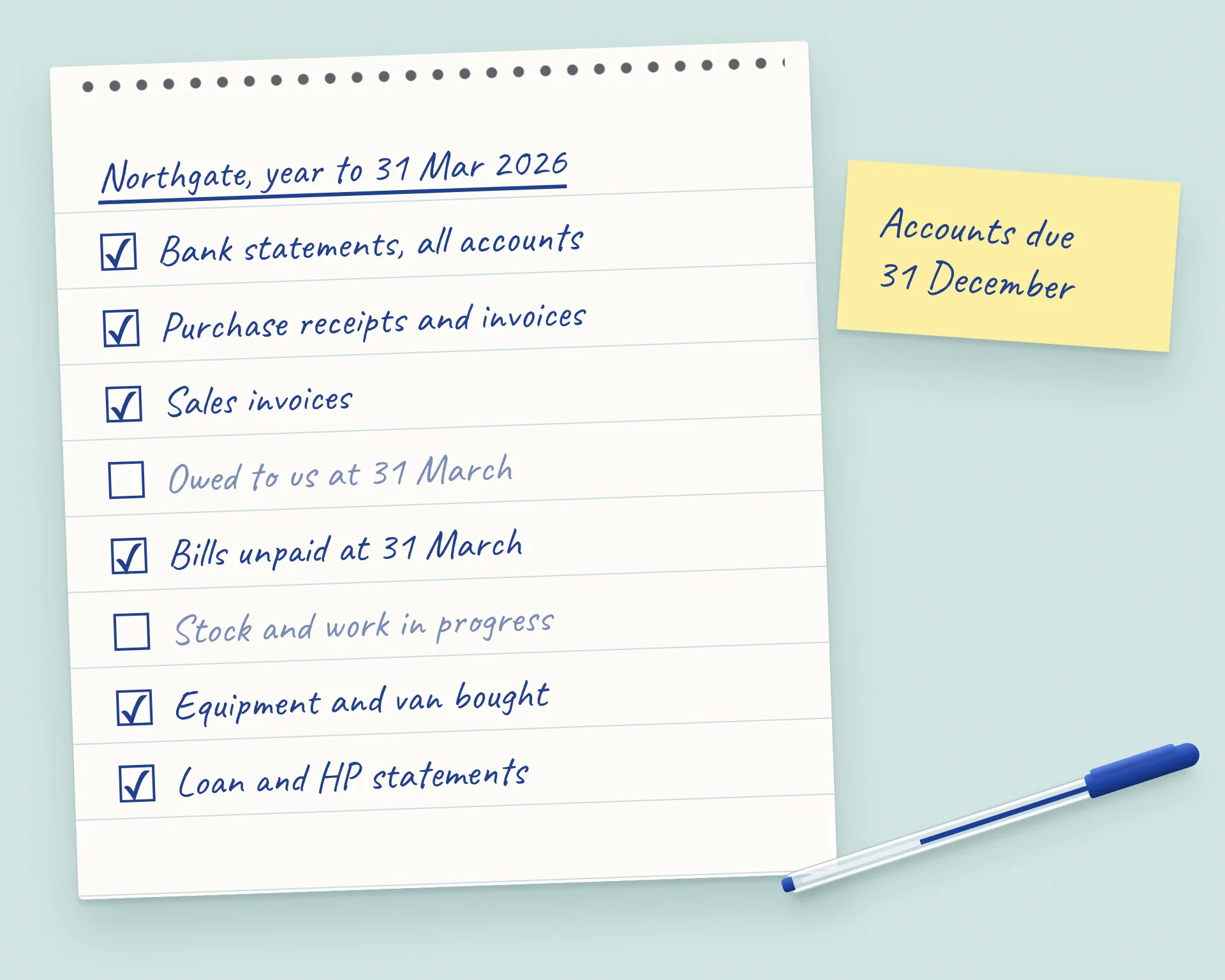
GOV.UK lists what a company’s accounting records include: all money received and spent, assets owned, debts it owes or is owed, stock at the end of the financial year and the stocktakings behind it, and other documents such as bank statements and correspondence.3 The checklist puts that in the words a client recognises:
Year end records: [company name], year to [31 March 2026] Bank and money ☐ Bank statements for every business account, credit card and loan, for the whole year ☐ Petty cash records Money spent ☐ Purchase receipts and supplier invoices not sent yet ☐ Invoices you still had to pay at the year end ☐ Invoices for anything bought to keep: equipment, tools, vehicles, computers Money received ☐ Sales invoices, if they are not in [your software] ☐ Customers who still owed you money at the year end ☐ Grants received At the year end ☐ The value of stock, and how it was counted ☐ Work in progress not invoiced yet ☐ Loan, lease and hire purchase statements ☐ Anything sold or scrapped during the year Anything else: contracts, letters from HMRC, correspondence about money owed
Year end checklist for a sole trader
A sole trader keeps records of all sales and income, all business expenses, VAT and PAYE records where they apply, and personal income; with traditional accounting, also what is owed each way, stock and work in progress, year end bank balances, and money put in and taken out.4
Year end records: [name], tax year [6 April 2025 to 5 April 2026] ☐ All sales and income: sales invoices, till rolls, bank slips ☐ All business expenses: receipts for goods and stock, supplier invoices ☐ Bank statements and cheque book stubs for the business account ☐ VAT records, if VAT registered ☐ PAYE records, if you employ anyone ☐ Records of other personal income for your tax return If you use traditional accounting rather than the cash basis, also: ☐ Money you were owed but had not received at the year end ☐ Bills you had received but not paid ☐ The value of stock and work in progress at the year end ☐ Your bank balances at the year end ☐ Money you put into the business, and money you took out for yourself
The records are kept for at least 5 years after the 31 January deadline of the tax year.5
Sending the checklist
Send it as soon as the year ends, with a date, and tick off what arrives. A covering email to copy is in emails to request receipts and documents from clients, with a reminder for when nothing comes.
Gathering the year in Daybook
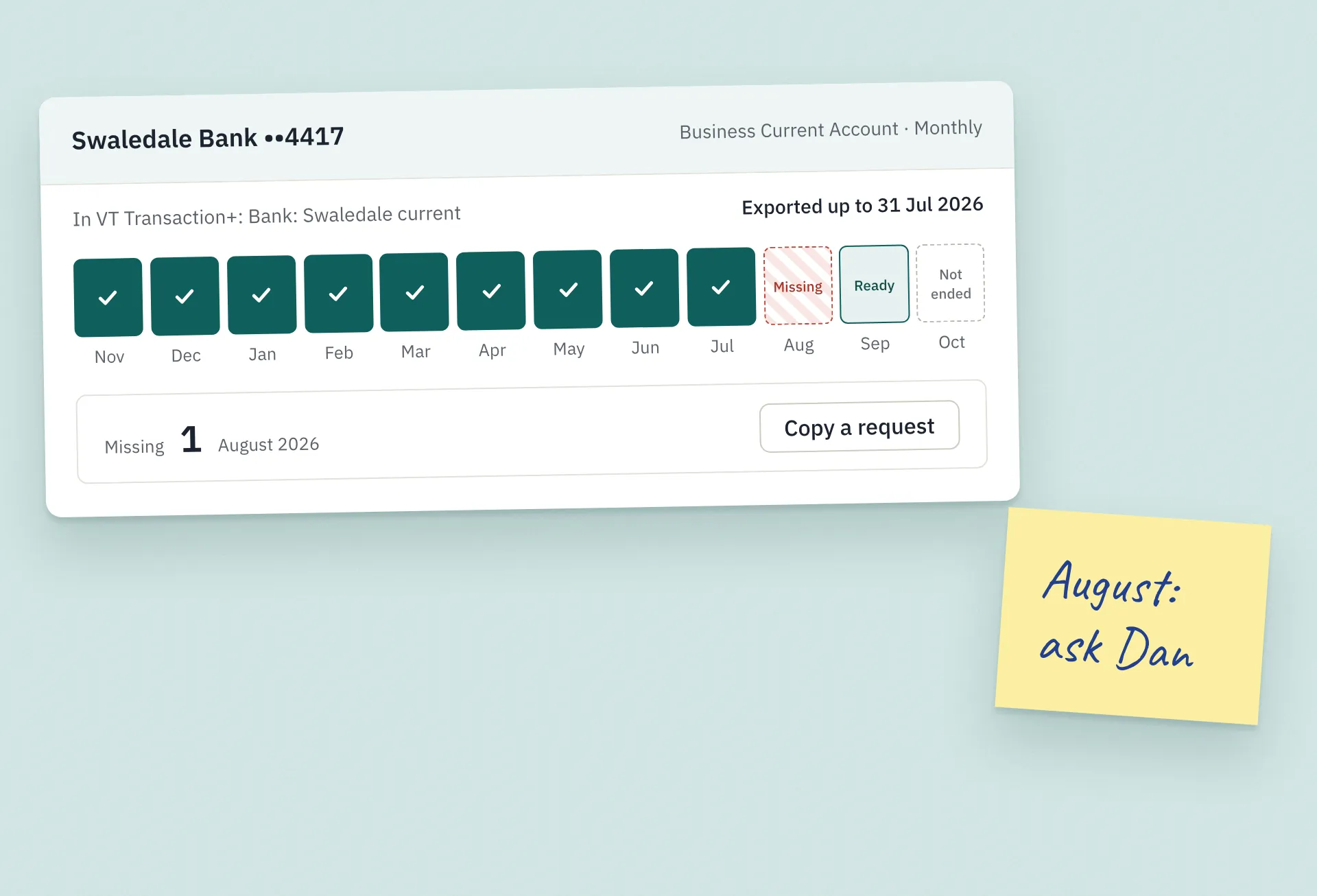
A client’s receipts and invoices for the year are read as they arrive, uploaded or emailed to their own Daybook address. Their bank statements sit on a timeline for each account, so a missing month is named before you start, with a request to copy, and earlier financial years can be shown for catch-up work.
At the end, the year’s purchases go out as the file for the client’s software, or as one PDF with a list at the front (year end and catch-up work in Daybook).
Doing this for clients every month? Try Daybook on one client’s month: free for 14 days, no card needed.
Questions
What information is needed for year end accounts?
For a company: all money received and spent, assets, debts owed and owing, stock at the year end and how it was counted, and documents such as bank statements.3
What records does a sole trader need for Self Assessment?
All sales and income, all business expenses, VAT and PAYE records where they apply, and records of personal income, with receipts, bank statements and sales invoices as proof.4
Read next
- Emails to request receipts from clientsEach month, after a VAT quarter, missing bank statements and the year end, with a reminder.
- PDF bank statements into your softwareWhat each program imports, converting a PDF or paper statement, and checking the balances.
- Receipts for an HMRC compliance checkHMRC’s upload form, 15MB a file and 10 at a time, and a period’s receipts as one PDF.
- How Daybook reads bank statementsThe same job in Daybook Capture, for every client.
Sources
Every fact on this page was checked against these on 19 October 2026.
- Accounts and tax returns for private limited companies (opens in a new tab), GOV.UK.
- Self Assessment tax returns: deadlines (opens in a new tab), GOV.UK.
- Running a limited company: company and accounting records (opens in a new tab), GOV.UK.
- Business records if you’re self-employed: what records to keep (opens in a new tab), GOV.UK.
- Business records if you’re self-employed: how long to keep your records (opens in a new tab), GOV.UK.