
VAT stagger groups and quarter end dates.
Every VAT registered business is in one of three stagger groups, which decides the months its VAT quarters end. Here are the quarter ends and return deadlines for staggers 1, 2 and 3, how to find a client’s stagger and change it, and the other return periods HMRC allows.
Last updated
In short
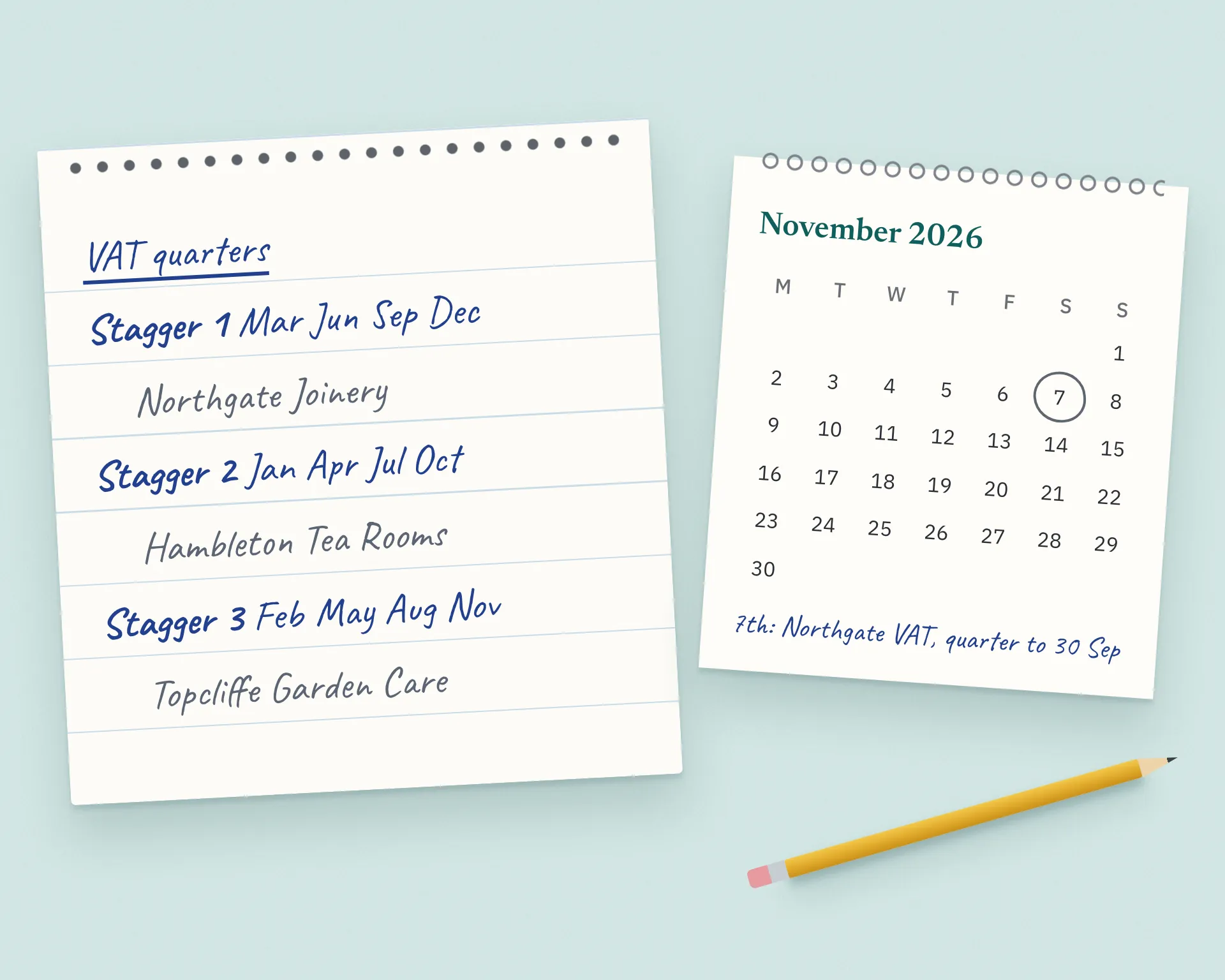
- Stagger 1: quarters end March, June, September and December. Stagger 2: April, July, October and January. Stagger 3: May, August, November and February.
- The return and the payment are usually due one calendar month and 7 days after the quarter ends: 7 May for a quarter ending 31 March.
- The deadline does not move for a weekend or bank holiday; a Direct Debit is collected 3 working days after it.
- A business can apply through its VAT online account for periods that fit its financial year.
- Daybook’s reminders can ask each client for its receipts after every VAT quarter, whichever stagger it is on.
Daybook’s reminder emails can ask each client for the quarter’s receipts after its VAT quarter ends, with a schedule for each stagger. Reminders after each quarter
Contents
What a VAT stagger is
A VAT return normally covers 3 months. So that returns do not all arrive at once, HMRC puts each business in one of 3 groups of tax periods when it registers, and the group decides the months its quarters end.1 HMRC’s own manuals call that group the business’s stagger.2
The three groups end their quarters on the last day of these months:
- Stagger 1
- March, June, September and December.
- Stagger 2
- April, July, October and January.
- Stagger 3
- May, August, November and February.
HMRC’s notice numbers them 1, 2 and 3 in that order, listing group 1 as June, September, December and March.1
VAT quarter end dates and return deadlines
The deadline for a VAT return is usually one calendar month and 7 days after the end of the period, and it is also the deadline for paying HMRC.3 That puts each stagger’s deadlines on the 7th of the second month after each quarter:
Stagger 1
| Quarter ends | Due |
|---|---|
| 31 Mar | 7 May |
| 30 Jun | 7 Aug |
| 30 Sep | 7 Nov |
| 31 Dec | 7 Feb |
Stagger 2
| Quarter ends | Due |
|---|---|
| 31 Jan | 7 Mar |
| 30 Apr | 7 Jun |
| 31 Jul | 7 Sep |
| 31 Oct | 7 Dec |
Stagger 3
| Quarter ends | Due |
|---|---|
| 28/29 Feb | 7 Apr |
| 31 May | 7 Jul |
| 31 Aug | 7 Oct |
| 30 Nov | 7 Jan |
The deadline stands even on a weekend or bank holiday.3 A business that pays by Direct Debit has the payment collected 3 working days after the deadline, once it has set the Direct Debit up at least 3 working days before sending the return.4
Finding a client’s VAT stagger
After registration HMRC sends the business information about when to submit its first VAT return and payment,6 and the return dates are kept in its VAT online account, where they can be changed.5
The month of any quarter end tells you the stagger: a quarter ending in March, June, September or December is stagger 1, in April, July, October or January stagger 2, and in May, August, November or February stagger 3.
Changing a client’s VAT stagger
A business can apply through its VAT online account for tax periods that fit its financial year,1 and the online account is where it updates its return dates, unless it has non-standard tax periods.5 A business that takes over another as a going concern and gets a new registration can apply to keep the previous business’s tax periods.1
A common reason to change is the year end. With a year ending 31 March, stagger 1 makes the last VAT quarter end on the same day, so the year’s fourth return and the accounts cover the same months.
HMRC does not always agree. Its VAT Accounting Manual covers stagger changed to gain a cash flow advantage, and businesses in sectors with a high risk of fraud or of VAT debt building up, where HMRC can move a business between monthly and quarterly returns or refuse monthly returns.2
Monthly returns, non-standard periods and annual accounting
- Monthly returns
- A business that normally expects repayments can ask for monthly tax periods, and makes 12 returns a year instead of 4. If it starts paying instead, it may have to go back to quarters.7
- Non-standard tax periods
- For accounting systems not based on calendar months, applied for in writing. Monthly ones end within 14 days, and quarterly ones within 20 days, of a standard period end, and the returns show the approved dates.8
VAT staggers and Making Tax Digital for Income Tax
Sole traders and landlords under Making Tax Digital for Income Tax send quarterly updates too. Those whose accounting period runs from 1 April to 31 March use calendar update periods, ending 30 June, 30 September, 31 December and 31 March,11 the same quarter ends as VAT stagger 1. A client on stagger 1 with a March year end has one set of quarters for both.
Reminders for each stagger in Daybook
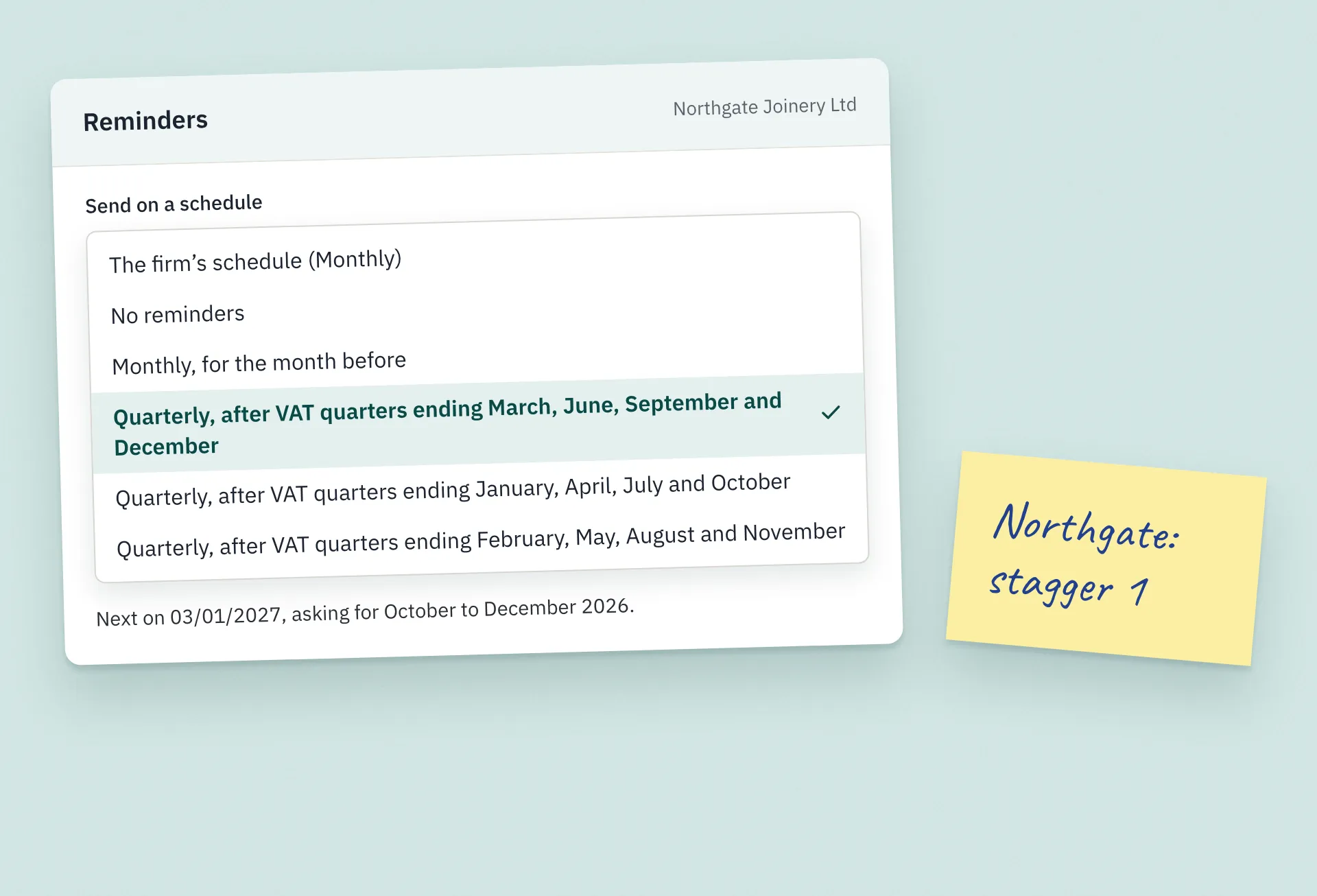
Daybook’s reminder emails ask clients for their receipts and invoices after each VAT quarter, with a schedule for each stagger: quarterly after VAT quarters ending March, June, September and December (stagger 1); January, April, July and October (stagger 2); or February, May, August and November (stagger 3).
The firm sets its usual schedule and the day of the month; each client can have its own. A reminder goes on that day after each quarter ends and asks for the quarter’s three months, in the firm’s name, with the client’s own Daybook address to send them to. Reminders are off until you turn them on.
The emails to send yourself, after a VAT quarter or when nothing has come, are in emails to request receipts and documents from clients.
Doing this for clients every month? Try Daybook on one client’s month: free for 14 days, no card needed.
Questions
What does VAT stagger mean?
The group of tax periods HMRC puts a business in when it registers, which decides the months its VAT quarters end. There are three, so that returns arrive evenly over the year.1
Which VAT stagger is March, June, September and December?
Stagger 1. Stagger 2 ends in April, July, October and January, stagger 3 in May, August, November and February.1
When is the VAT return due for a quarter ending 31 March?
Usually by 7 May: one calendar month and 7 days after the end of the period. The payment is due by the same day.3
Can I change my VAT stagger?
Is the VAT deadline later when it falls on a weekend?
No. The return has to be sent, and the payment has to reach HMRC, by the deadline even on a weekend or bank holiday.3
Read next
- Emails to request receipts from clientsEach month, after a VAT quarter, missing bank statements and the year end, with a reminder.
- VAT codes for purchasesEach program’s purchase VAT codes, box 7, and the code for a supplier not VAT registered.
- Year end records checklistTwo checklists to send clients, a limited company and a sole trader, from GOV.UK’s lists.
- Reminders after each quarterThe same job in Daybook Capture, for every client.
Sources
Every fact on this page was checked against these on 18 October 2026.
- VAT guide (VAT Notice 700), paragraph 20.3: tax periods (opens in a new tab), HMRC, updated 25 June 2026.
- VAT Accounting Manual, VATAC4100: using the discretion to direct stagger (opens in a new tab), HMRC, updated 4 October 2021.
- Sending a VAT Return: when to do a VAT Return (opens in a new tab), GOV.UK.
- Pay your VAT bill: pay by Direct Debit (opens in a new tab), GOV.UK.
- Register for VAT: changing your VAT details (opens in a new tab), GOV.UK.
- Register for VAT: after you register (opens in a new tab), GOV.UK, updated 10 October 2024.
- VAT guide (VAT Notice 700), paragraph 20.3.2: monthly tax periods (opens in a new tab), HMRC, updated 25 June 2026.
- VAT guide (VAT Notice 700), paragraph 20.3.3: non-standard tax periods (opens in a new tab), HMRC, updated 25 June 2026.
- VAT Annual Accounting Scheme: return and payment deadlines (opens in a new tab), GOV.UK.
- VAT Annual Accounting Scheme: eligibility (opens in a new tab), GOV.UK.
- Use Making Tax Digital for Income Tax: send quarterly updates (opens in a new tab), HMRC, updated 16 October 2026.